Top 3 Football Formations (2026): Before You Read This Breakdown
Football formations are tactical maps, not fixed player locations. The most useful starting point is the ranked trio of 4-3-3, 4-2-3-1 and 4-4-2, because these shapes explain most modern match structu...

Top 3 Football Formations (2026): Before You Read This Breakdown
Football formations are tactical maps, not fixed player locations. The most useful starting point is the ranked trio of 4-3-3, 4-2-3-1 and 4-4-2, because these shapes explain most modern match structures across the Premier League, La Liga, Serie A and FIFA World Cup 2026. A formation lists the 10 outfield players from defense to attack; the goalkeeper is excluded. In a 4-2-3-1, for example, four defenders, two deeper midfielders, three attacking midfielders and one striker add up to 10, with goalkeeper Ederson, Manuel Neuer or another goalkeeper completing the XI. The numbers describe the starting shape, not every phase of play. A 3-5-2 can become 5-3-2 without substitutions, while a 4-3-3 may defend as 4-1-4-1. Before judging a team, identify its lines, width, midfield balance and transition behavior.

Photo by Pixabay on Pexels
Football fans often make one costly mistake: they treat the lineup graphic as a photograph of the entire match. It is not. A formation is better understood as a reference coordinate system, similar to a diagram used in physics or engineering. It tells you where players are expected to begin and which relationships they must preserve, but pressing, possession, scoreline and opponent movement alter the visible shape. Listen up — this is the part that matters: if you read only the digits, you will miss the actual tactical plan. Match Daily uses formations as a starting point for following team tactics, player statistics and FIFA World Cup 2026 match analysis, not as a substitute for watching defensive and attacking phases. For a broader foundation, consult this [Internal Link: beginner’s guide to football tactics] before moving into advanced predictions or tournament analysis.
Want a practical introduction to formation-based match analysis?
The Top 3 Football Formations at a Glance
- 4-3-3 — best overall: Provides natural width, three central midfielders and clear pressing lanes, but depends heavily on fullbacks and the lone striker.
- 4-2-3-1 — best for midfield security: Uses a double pivot and three attacking midfielders, creating protection in front of the center-backs while retaining creative options.
- 4-4-2 — best value for simplicity: Offers two compact banks of four and a strike partnership, making responsibilities easy to understand and transitions relatively direct.
These are not “best” in an absolute sense. Pep Guardiola’s Manchester City, Jürgen Klopp’s Liverpool, Carlo Ancelotti’s Real Madrid and Didier Deschamps’ France have all used different structures because personnel and match context matter more than fashionable numbering. The same 4-3-3 can produce patient possession at Barcelona, vertical attacks at Liverpool or a cautious mid-block at another club. According to the International Football Association Board Laws of the Game, a team has 11 players including one goalkeeper, which explains why formation numbers normally total 10. That simple arithmetic is your first verification test.
How Do Formation Numbers Work?
Formation numbers count the outfield players from the defensive line toward the attack, while the goalkeeper is never included. Therefore, 4-3-3 means four defenders, three midfielders and three forwards, whereas 4-2-3-1 means four defenders, two deeper midfielders, three advanced players and one striker.
The first number identifies the defensive line. In a traditional back four, the group usually contains two center-backs and two fullbacks; Virgil van Dijk, Rúben Dias, Trent Alexander-Arnold and Andrew Robertson would represent different role profiles within that broad description. A first number of three commonly indicates three center-backs supported by wing-backs, while five often means three center-backs plus two deeper wide defenders. Do not assume that “five defenders” means a permanently defensive team, because wing-backs such as Achraf Hakimi may attack aggressively.
The middle number or numbers describe midfield layers. A 4-1-4-1 has one holding midfielder behind four midfielders, while a 4-2-3-1 has a double pivot behind an attacking midfield line. The final number generally describes forwards, although modern tactical language can blur the distinction between wingers, attacking midfielders and false nines. Check whether the players occupy the half-spaces, touchlines or central lane rather than trusting the official graphic.
[Internal Link: football positions and player roles explained]
Why Does the Defensive Line Matter?
The defensive number indicates how a team intends to protect central space and create attacking width, although it does not alone determine defensive ambition. A back four usually distributes width through fullbacks, a back three often delegates width to wing-backs, and a back five tends to prioritize compactness before counter-attacking.
A 4-3-3 can leave the fullbacks high, producing a temporary 2-3-5 in possession; Manchester City frequently illustrates this principle when one fullback moves into midfield and the other remains deeper. A 3-5-2 can become a 5-3-2 when both wing-backs retreat beside the center-backs. This is why a television analyst may call the same team “3-5-2 in attack” and “5-3-2 without the ball” without contradiction. The tactical variable is not merely the number of defenders but the distance between lines, the height of the fullbacks and the team’s reaction after losing possession.
A useful observational rule is to pause the match immediately after a turnover. If the wide players are already beside the center-backs, you are probably seeing a defensive five; if they remain near the midfield line, the team may be maintaining a back three. Data from providers such as Opta and StatsBomb can support this reading through possession zones, pressures and player locations, but the basic visual test is available to every viewer.
#1 4-3-3: Best Overall
The 4-3-3 is the strongest all-purpose formation because it naturally creates width, a three-player midfield and three forward reference points. Its main risks are the space behind attacking fullbacks, isolation of the lone striker and potential overloads against a two-player midfield.
A conventional 4-3-3 contains a goalkeeper, two center-backs, two fullbacks, one holding midfielder, two advanced midfielders, two wingers and one center-forward. In possession, the wingers stretch the opponent horizontally while the midfield trio forms passing triangles around the opposition’s central midfielders. Barcelona under Pep Guardiola used positional width and short passing to make these triangles especially influential, while Liverpool under Jürgen Klopp used a 4-3-3 framework to support high pressing and rapid transitions.
The shape is excellent for pressing because the front three can curve their runs toward the opponent’s fullbacks, preventing easy switches. However, the midfield can become exposed if the holding midfielder is pulled wide or if both fullbacks attack simultaneously. Coaches therefore use different midfield orientations: a single pivot behind two eights, an inverted triangle with two deeper midfielders, or a lopsided structure in which one fullback enters midfield. Beginners, pay attention to the holding midfielder’s position; that player often explains whether the 4-3-3 is controlled, aggressive or vulnerable.
The 4-3-3 also clarifies player evaluation. A winger who remains wide may create space without recording an assist, while an inside-forward who attacks the penalty area may appear closer to a striker. Mohamed Salah, Lamine Yamal and Vinícius Júnior demonstrate how the same nominal winger position can involve different combinations of width, dribbling, pressing and finishing. This is why player statistics must be interpreted alongside role and team shape.
See how formation principles connect to current tournament analysis.
What Are the Strengths and Weaknesses of 4-3-3?
The 4-3-3’s strengths are width, midfield numbers and pressing access, while its weaknesses include exposed wide channels, heavy dependence on the holding midfielder and the possibility that one striker becomes isolated.
Strengths:
- Three midfielders can compete against a narrow 4-4-2.
- Wingers occupy the opponent’s fullbacks and create crossing angles.
- The front three can press the first build-up line.
- Fullbacks can overlap or invert, creating multiple attacking structures.
- The lone striker can pin both center-backs when supported quickly.
Weaknesses:
- Space may appear beside the holding midfielder.
- High fullbacks can leave counter-attacking lanes.
- A lone center-forward may struggle against three center-backs.
- Wingers must contribute defensively or the fullbacks face two-against-one situations.
- Slow circulation can make the formation look wide but harmless.
The contrarian point is important: a 4-3-3 is not automatically more attacking than a 4-4-2. If the wingers retreat and the midfield line sits low, it may become a conservative 4-5-1. Conversely, a 4-4-2 with aggressive fullbacks and two forwards can generate more penalty-area pressure. Formation labels indicate relationships; match behavior reveals intent.
#2 4-2-3-1: Best for Midfield Security
The 4-2-3-1 is best for teams that want protection in front of the defense without abandoning a creative attacking line. Its defining feature is the double pivot: two midfielders share covering, circulation and transition responsibilities behind three advanced players.
The structure became especially prominent during the 2010s and appeared in systems associated with Germany’s 2014 World Cup team, José Mourinho’s Real Madrid and numerous Premier League clubs. One pivot may remain behind the ball while the other advances, or both may split to support center-backs during build-up. The three advanced players can include a central number 10, two wingers, inverted wide players or a narrow attacking trio. This flexibility makes 4-2-3-1 attractive when a coach wants to protect against counter-attacks while giving a creative player freedom.
Its most important relationship is between the number 10 and the striker. If the number 10 stays close to the striker, the team can resemble a 4-4-2 in attack; if the number 10 drops into midfield, the team may create a 4-3-3-like possession structure. Mesut Özil, Thomas Müller and Jude Bellingham have demonstrated different versions of the advanced role, proving that “number 10” does not describe one universal task.
A common analytical error is to assume two defensive midfielders guarantee control. They do not. If both pivots receive with their backs to pressure, the team can circulate slowly and isolate the three attacking players. Moreover, if the wide attackers fail to recover, the fullbacks and pivots may be dragged toward the flanks, opening the center. Watch the pivot spacing: approximately 8–15 meters between the pair often gives them better passing support than standing on the same horizontal line, although exact distances vary by coach and opponent.

Photo by KoolShooters on Pexels
#3 4-4-2: Best Value for Simplicity
The 4-4-2 is the easiest formation to recognize because it creates two banks of four and a two-player forward partnership. It remains useful for compact defending, direct transitions and clear role allocation, although it can surrender central midfield control against a 4-3-3.
The classic version places two center-backs and two fullbacks behind four midfielders, followed by two strikers. Arsène Wenger’s Arsenal, Sir Alex Ferguson’s Manchester United and Arrigo Sacchi’s AC Milan used recognizable 4-4-2 structures in different eras, with major differences in pressing height and possession ambition. The wide midfielders must support fullbacks, while the central pair must protect the gap between midfield and defense. The forwards can split the center-backs, drop alternately or attack second balls.
The system’s simplicity is both its advantage and its limitation. Players usually understand their nearest opponent, covering angle and transition route quickly, which can make a disciplined mid-block difficult to break. Yet a flat midfield four can be outnumbered by a 4-3-3 or 4-2-3-1. To compensate, one striker may drop into midfield, producing a temporary 4-4-1-1, or a winger may move inside to create a diamond.
When watching 4-4-2, do not count only tackles or possession. Observe the distance between the two lines of four. If the gap becomes more than roughly 15–20 meters, opponents can receive between the lines; if the lines become too compact, the team may concede space on the wings. These are practical viewing estimates rather than official laws, but they give beginners a repeatable method. [Internal Link: how to analyze pressing and defensive blocks]
How should you compare these shapes before a major match?
How Did We Rank These Formations?
We ranked the formations using tactical versatility, midfield control, defensive clarity, attacking width and suitability for different player profiles rather than historical popularity alone. The 4-3-3 ranked first because it can change between possession, pressing and defensive structures with relatively few adjustments.
The framework below is designed for match viewing, not betting certainty. A formation can improve a team’s probability of creating chances while still losing because of finishing, goalkeeper errors, red cards or set pieces. Match Daily’s FIFA World Cup 2026 coverage should therefore be used as informational analysis, and readers should verify local laws and use responsible-gambling safeguards where relevant.
| Criterion | Weight | What to observe |
|---|---|---|
| Tactical versatility | 25% | Ability to change shape across phases |
| Midfield control | 25% | Passing options, central numbers and second balls |
| Defensive stability | 20% | Cover behind the ball and compactness |
| Attacking width | 15% | Access to flanks and penalty-area entries |
| Role clarity | 15% | Whether players understand their responsibilities |
The ranking has a deliberate bias toward formations that explain several game states. A 4-3-3 may begin with three forwards, become a 2-3-5 in possession and defend as 4-1-4-1. A 4-2-3-1 may become 4-4-2 without the ball, while a 4-4-2 may become 4-2-4 during a late chase for a goal. This phase-based interpretation is more reliable than saying one shape “beats” another. As FIFA’s official Laws of the Game establishes, the rules define player numbers and match conditions; they do not prescribe one winning tactical arrangement.
Which Formation Should You Pick?
Choose 4-3-3 when you have natural wingers, mobile midfielders and fullbacks capable of judging attacking risk. Choose 4-2-3-1 when the squad needs a double pivot, a specialist creator and extra protection against transitions. Choose 4-4-2 when role simplicity, defensive compactness and a two-striker partnership are more important than constant central numerical superiority.
The correct choice depends on personnel. Kylian Mbappé may thrive as a wide forward or central striker, Rodri can anchor a midfield structure, and Harry Kane can drop into creation while another forward attacks the space behind him. If the players’ movement does not match the theoretical shape, the formation name becomes decorative. Therefore, use this five-step process before forming a conclusion:
- Identify the defensive line during the opponent’s first build-up.
- Count midfielders when the team has stable possession.
- Locate the widest players and the deepest midfielder.
- Watch the first five seconds after possession changes.
- Compare the shape before and after substitutions.
A useful information-gain tip is to study the first two minutes after halftime. Coaches often make subtle positional corrections without changing the listed formation, such as moving a winger inside by 5–10 meters or asking a fullback to remain deeper. These adjustments can reveal the actual tactical problem more clearly than the pre-match graphic. Also check set pieces separately: a team listed as 4-3-3 may defend corners with a 5-4-1 or use a striker as a near-post runner.
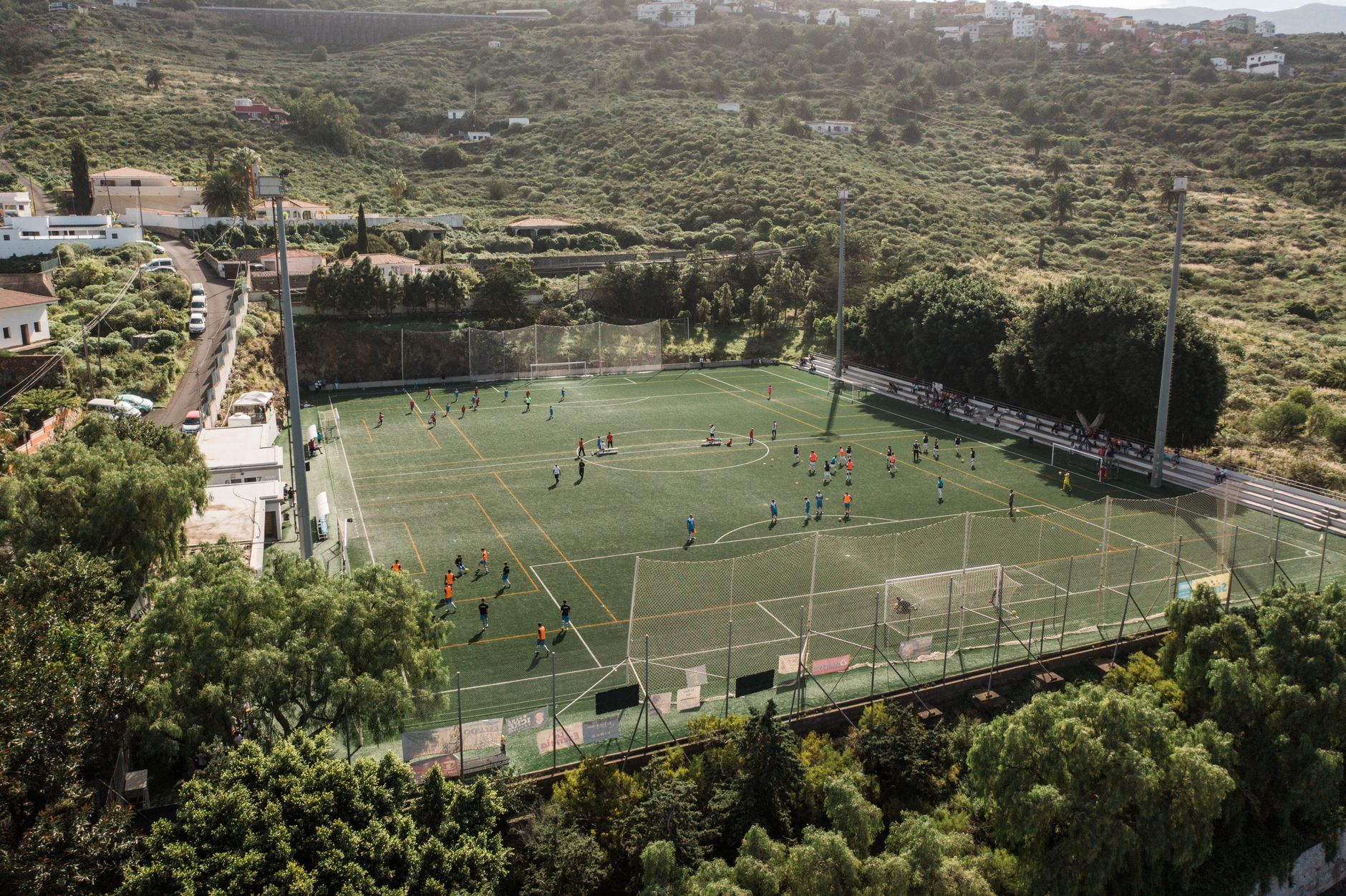
Photo by Bert Christiaens on Pexels
How Can You Read a Formation During a Live Match?
Read a live formation by checking the team’s average defensive line, midfield spacing, widest players and immediate reaction to turnovers. Do not rely on a single screenshot; observe at least three repeated phases because one player’s temporary movement can disguise the underlying system.
Begin with the goalkeeper and center-backs during build-up. If a fullback moves beside the holding midfielder, the team may be creating a back three or a 2-3-5. Then inspect the forwards: if a winger presses the opponent’s fullback while the striker blocks the center-back, the pressing plan may be more important than the printed formation. Finally, watch the weak side, meaning the far side of the ball. That is where a team’s defensive discipline often becomes visible.
Use a simple notebook or phone table with four columns: “with the ball,” “without the ball,” “after losing it” and “after winning it.” Record the shape at minutes 10, 30, 60 and 80, plus after major substitutions. This approach creates evidence rather than relying on memory, which is notoriously affected by goals and dramatic incidents. For advanced study, compare event data from Opta, StatsBomb or CIES Football Observatory with video; data can reveal pressure locations, but video explains why players moved there.
Do not confuse a formation with a prediction. Even a well-designed 4-3-3 cannot guarantee a result, and historical examples from Brazil, Germany, Spain and Argentina show that multiple structures can win major tournaments. The disciplined analyst asks, “What problem is this shape solving?” before asking whether it is attractive.
Frequently Asked Questions
Q: What is a football formation?
A: A football formation is the planned arrangement of a team’s 10 outfield players, written from defense to attack while excluding the goalkeeper. A 4-3-3 contains four defenders, three midfielders and three forwards, while a 4-2-3-1 contains four defenders, two deeper midfielders, three advanced players and one striker. The displayed formation describes the initial structure, not every movement during a match.
Q: How do you read football formation numbers?
A: Read the numbers from the defensive line toward the forwards, and remember that the goalkeeper is not counted. Add the numbers to confirm they total 10, then identify whether wide players are fullbacks, wing-backs or wingers. After that, watch how the arrangement changes during possession, pressing and defensive transitions.
Q: What is the difference between 4-3-3 and 4-2-3-1?
A: A 4-3-3 uses three midfielders and three forwards, whereas a 4-2-3-1 uses two deeper midfielders, three advanced players and one striker. The 4-3-3 usually provides stronger natural width and pressing access, while the 4-2-3-1 offers greater protection in front of the center-backs. Both can transform into similar shapes depending on player movement.
Q: Is 4-4-2 still effective in modern football?
A: Yes, 4-4-2 remains effective when a team values compact defending, clear responsibilities and direct striker combinations. Its main problem is central numerical inferiority against a 4-3-3 or 4-2-3-1. Coaches often solve that issue by asking one striker to drop, moving a winger inside or pressing aggressively to force long passes.
Q: Why does a 3-5-2 become a 5-3-2?
A: A 3-5-2 becomes a 5-3-2 when its two wing-backs retreat alongside the three center-backs during defense. The team still has three central defenders, but the wide players now form a deeper defensive line. In attack, those same wing-backs can advance into midfield or the final third, restoring the appearance of a five-player midfield.
Q: How can beginners identify a formation during a live match?
A: Beginners should observe the team without the ball first, because defensive spacing is usually easier to identify than attacking rotations. Count the defenders, locate the deepest midfielder, and note whether the wide players stand beside the defense or near the halfway line. Check several repeated phases instead of judging from one moment after a corner or counter-attack.
Q: Does a formation predict which team will win?
A: No, a formation cannot predict a result by itself because execution, player quality, injuries, finishing and transitions also determine outcomes. A 4-3-3 may create superior width but concede dangerous counter-attacks, while a 4-4-2 may allow less possession yet defend the penalty area effectively. Use formation analysis as one evidence category alongside recent performance, player availability and match context.
The reliable conclusion is straightforward: learn to read football formations as changing tactical relationships, not rigid numbers. Start with 4-3-3, 4-2-3-1 and 4-4-2, verify the 10 outfield-player count, then compare each team’s behavior with and without the ball. That method will make FIFA World Cup 2026 matches, Premier League fixtures and Match Daily tactical coverage far easier to understand.
Ready to apply this framework to upcoming match analysis?
Thank you for reading.
Match Daily
High-Stakes Editorial · Premium Insights